You might not be a direct competitor of OpenAI or Google. But, if you’re a tech company looking to hire and grow in the AI space, you’re directly competing with these giants for AI skills in demand. What can you do?
The AI talent shortage is reaching a crisis point. AI-related job postings have risen by 21% every year since 2019. Over the next two years, AI job demand could increase to 1.3 million jobs, while qualified candidates with AI skills in demand for platform companies will only reach 645,000.
Despite this fact, enterprises in the AI ecosystem are still trying to build an in-house team of AI experts using traditional, enterprise AI hiring strategies.
Non-frontier tech companies developing AI-driven products are going up against giants like OpenAI, Google, and Meta in the competition for AI engineer skills in demand. Meta has offered OpenAI employees signing bonuses as high as $100 million. If your business plans to develop AI-driven products, tools, and platforms, traditional AI platform hiring strategies aren’t going to cut it.
Unless you have hundreds of millions to throw at talent acquisition (and years to build up an AI product development team), your organization needs to rethink its approach to the AI talent shortage.
If traditional hiring methods aren’t effective, how should enterprises address AI skills in demand for non-frontier technology companies? What are the AI skills in demand that enterprise AI product builders are struggling to find? How can your organization upskill for AI?
AI Skills in Demand for Platform Companies
The rising demand for AI-native products has created a rush of AI software hiring. Enterprise tech companies need specialists who can architect scalable solutions, integrate models into new and existing applications, and ensure well-structured data pipelines. While some AI engineers have grown to meet the AI skills gap, most of the projects organizations are undertaking didn’t exist 5-10 years ago.
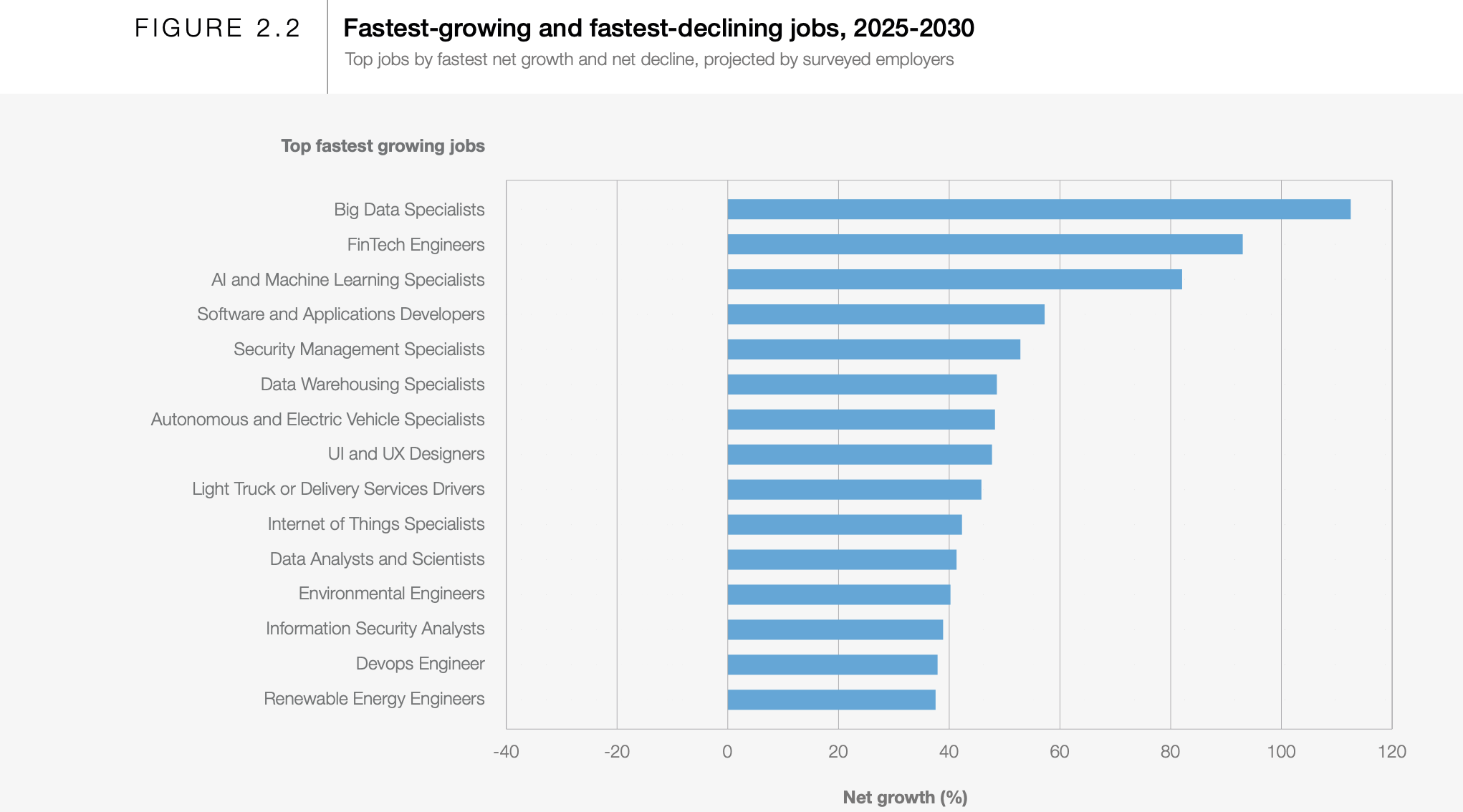
Source: World Economic Forum
AI and machine learning specialists, big data engineers, and software developers are the fastest-growing technical roles worldwide. The hardest to fill AI skills in demand for enterprise tech companies today are:
- Machine Learning and Data Science: Enterprises need experts who can design and train the models that power AI systems. Professionals who can fine-tune pretrained models on proprietary data and optimize them for unique AI capabilities are in especially high demand.
- Software Engineering and AI Integration: Developers who can embed AI into existing enterprise systems bridge the gap between innovation and implementation. AI skills such as integrating APIs, orchestrating workflows, and optimizing inference are essential for scaling AI solutions.
- Data Engineering and Pipeline Architecture: AI product initiatives fail without reliable, well-structured data pipelines. AI skills in demand for enterprise tech companies are the ability to unify fragmented data sources, automate transformations, and ensure real-time accessibility.
- AI Ecosystem and Governance Roles: As AI adoption matures, organizations need specialists in MLOps, AI product management, and governance to ensure scalability, reliability, and compliance.
Looking for immediate access to these AI skills in demand? Gigster can assemble an AI development team in weeks to help you get started. AI Development Services
Unorthodox Strategies to Solve the AI Talent Shortage
While upskilling and outsourcing are time-tested strategies for overcoming a talent shortage - and ones that your competitors are likely doing - your organization can go a step further to gain access to AI skills in demand for enterprises. Here are some unconventional ways enterprises have started to access, cultivate, and retain AI talent.
Talent Swaps
Some AI technology companies are engaging in cross-industry “talent swaps” to exchange AI engineers or data scientists for short-term assignments. This gives teams exposure to new domains and technologies, diversifies skill sets across participating organizations, and fosters collaboration between non-competing enterprises. Working with a fully-managed distributed AI team is another way to gain the benefits of talent swaps without the need to join a specific alliance or consortium.
Forward-Deployed Engineers
Forward-Deployed Engineers (FDE) are engineers who alternate between customer teams, core product engineering teams, and technical consulting. They do a mix of software, sales, and platform engineering. Outsourcing, upskilling, or hiring for this role can accelerate knowledge transfer between technical and non-technical teams and ensure AI technology aligns with user pain points and business goals. The greater non-technical visibility can help increase the perceived value of technical talent and lead the organization’s overall culture towards more AI adoption and upskilling.
AI Challenge Contests and Open Innovation Platforms
Enterprises building customer-facing AI technologies can also crowdsource AI skills in demand through AI competitions, hackathons, and open research challenges. AI challenge contests attract global participation and uncover hidden talent while solving real technical challenges. This approach turns talent acquisition into a scalable, performance-based process rather than a lengthy, interview-heavy hiring cycle.
Academic Partnerships
Tech companies developing AI products are forming deep partnerships with universities, research labs, and technical institutions to create talent pipelines before graduates enter the job market. These collaborations can include co-funded research projects, joint AI labs, and internships that offer students real enterprise problems to solve. Beyond talent acquisition, academic partnerships allow enterprises to shape curriculum to better address AI skills in demand for enterprises, ensuring a more prepared future workforce.
Focus on Retention
Attracting top AI engineers is hard enough amidst the current AI talent shortage. Retaining them while competitors are offering multimillion-dollar compensation packages makes it even harder. Focusing on retention strategies that go beyond salary is the key to building, and keeping, an AI product development team. Platform companies should focus on challenging employees intellectually, offering ownership over product direction, and nurturing career growth. Providing AI engineers with opportunities to publish research, build cutting-edge models, and work on new innovations will help keep them engaged. A clear technical career path, flexible work arrangements, and access to industry-leading knowledge and resources are all must-haves for a competitive enterprise AI hiring strategy.
For more ideas on recent hiring trends, check out our article: New Trends for Staff Augmentation.
Gigster Talent on Demand
Balancing Cost, Speed, and Ownership
The unorthodox strategies to solve the AI talent shortage for non-frontier tech companies mentioned above are all critical for staying competitive in today’s talent landscape. However, most of them still involve the cost and time challenges inherent in building an internal AI product team. This presents a structural challenge that all AI product companies face. The cost of building an internal team with all the AI skills in demand is skyrocketing, hiring cycles are too slow for the current pace of AI, and the skills required to develop AI products shift every 3-6 months.
Winning teams aren’t choosing between in-house or outsourced development teams, they’re designing hybrid models that maximize ownership while accelerating speed and reducing costs.
The Challenges of Scaling Enterprise AI Hiring Strategies
The economics of building a successful AI technology company with traditional hiring strategies is becoming more and more challenging:
- AI skills in demand for enterprises come with an increased cost. Wage premiums for AI skills reached 56% in 2025, compared to only 25% in 2024.
- Building a competitive AI development team takes time. SmartRecruiters found the average days to hire for a tech role was 48 days in 2025.
- Investor expectations put even more pressure on AI startups to scale and reach profitability quickly. The top AI-driven startups are averaging $3.48 million in revenue per employee compared to $200,000 for traditional SaaS companies. This creates nearly unattainable burn rate benchmarks for AI startups to hit.
How Hybrid Teams Fill AI Skills in Demand for Enterprises
Instead of relying solely on internal AI development teams - and the AI talent shortage challenges that go along with them - tech companies are benefiting from a hybrid structure. Core in-house teams can remain responsible for the product vision, roadmap, and long-term architecture. Outsourced AI development teams can help accelerate development cycles, provide specialized expertise, and fill short-term needs on a fractional basis.
This approach helps address the challenges of scaling an internal AI development team during the current talent shortage without allowing your AI adoption to fall behind. The hybrid model provides:
- Faster hiring cycles: Assemble AI development teams in 1-2 weeks, compared to the 6-12 months it takes to build an in-house team.
- Lower costs: Avoid permanent commitments for specialized roles that may only be needed for a short time (and usually come with a wage premium).
- Access to niche AI talent: Fractional hiring provides access to specific AI knowledge at the stage of the product development cycle when it is actually needed.
- Scalable teams: Easily scale your AI development team up or down based on roadmap priorities, funding cycles, and product pivots.
- Agile and experimental: Full-time hires can make changing direction slow and expensive. Hybrid teams make it easy to experiment with new product features and AI opportunities, a critical skill in today’s fast-paced environment.
The AI skills in demand for enterprises today represent more than just a hiring challenge. They’re a defining factor in whether your company will remain competitive in the new AI landscape.
AI tech companies relying on traditional enterprise AI hiring strategies will fall behind as the AI skills gap widens. Enterprises competing in the AI product development race in 2026 and beyond won’t be those with the biggest recruiting budgets. They’ll be the ones willing to adapt.
If your organization is building customer-facing AI technologies and is ready to quickly scale its AI teams or accelerate your AI product roadmap, Gigster Talent on Demand gives you instant access to a team of world-class AI developers, data scientists, and ML engineers. Hire Gigster today to get started and close the AI skills gap.